

|
An 1840 Freight Money Usage
In 1838, the British & American Steam Navigation Company began a "Freight Money" letter service. For a fee, which had to be prepaid, and was collected by either the United States or the Canadian Post Office, a trans-Atlantic letter would be carried on one of their steamers. Other private companies soon provided similar services. Freight Money letters are relatively rare with fewer than 200 examples in total reported by Charless Hahn. The American Stampless Cover Catalog, Volume II, provides a good listing of the reported covers by city of origin.
Many of the known letters are difficult to recognize because the the private fees and postage are often combined into a single total figure by the Post Office of origin. An exception to this, and the most clearly delineated of the usages, are the five reported covers that originated in Richmond, Virginia. The Postmaster at Richmond marked "Paid Steam" with handstamps on the verso of the letter as well as the fee of 25 cents. Then, on the front of the letter, he marked "Paid" and the inland postage.
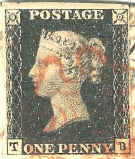
The finest Freight Money letter extant, and the only reported example of a Great Britain penny black on a forwarded freight money letter is shown below. It is currently available for purchase, subject unsold.
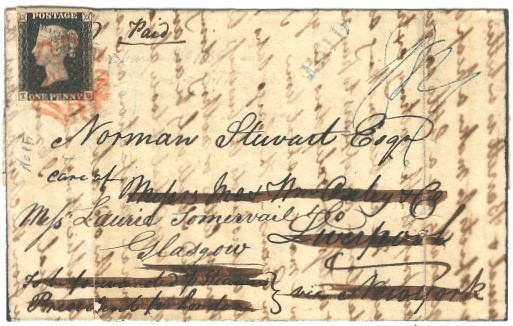
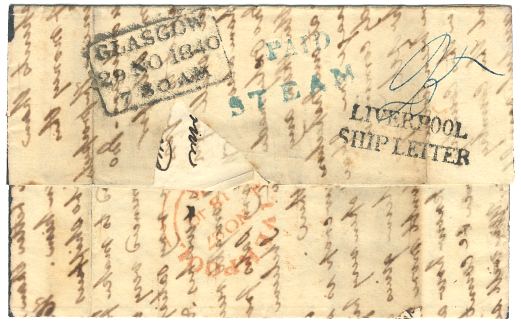
Above is an image of the front and reverse of an October 29, 1840 folded letter from Richmond, Virginia to Liverpool, England. It was prepaid by sender 25 cents freight money fee ("Paid Steam" handstamps and blue manuscript 25 fee) and the front was postmarked with blue "Richmond Va" circular date stamp, "Paid" handstamp and manuscript "18¾" cents postage rate for carriage to New York City. The letter was endorsed by sender "To be forwarded p steamer President for London". When the letter arrived at New York City it was turned over to the Purser of the President* along with the 25c fee that had been collected. When the steamer arrived at Liverpool the letter received the two line "Liverpool Ship Letter" backstamp and was rated in manuscript on front "8" pence due. The letter was collected by original addressee, who paid the 8d. postage due, and on November 27, 1840 the letter was forwarded from Liverpool to Glasgow with a one penny black (plate 5, position TB) tied by a maltese cross cancel. It arrived in Glasgow on November 29, 1840.
* The steamer President of the British & American Steam Navigation Company was a vessel of 2,366 tons. After only a few trips the steamer sank on March 11, 1841 with the loss of 120 passengers, including actor Tyrone Power. It is noted as being the first passenger steamer sunk as the result of striking an iceberg.
Richard Frajola (December 1, 2001)