HOME   BOARD    CONTACT


Roman Coins

The images are thumbnails. Click on them to see larger version. For information on the person, click name.

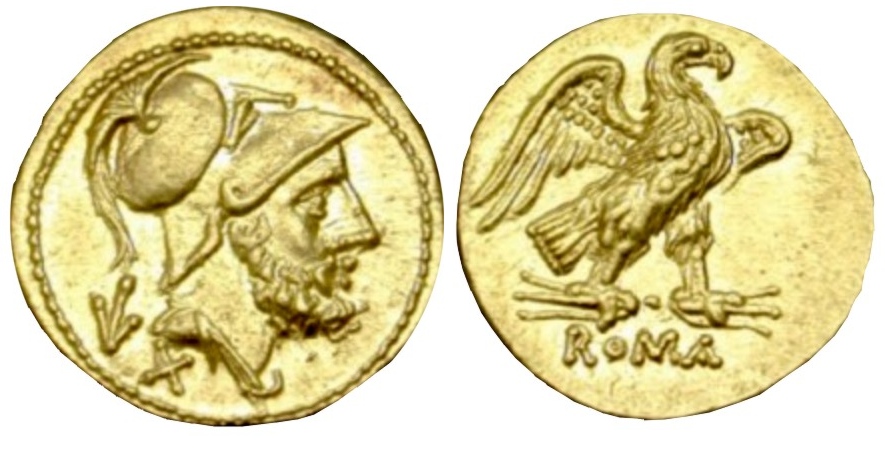
Anonymous
(211 BC)
gold 60 asses,  3.4g, S 3, RF R-7, 211-208 B.C.

Obv. Helmeted head of bearded Mars r, mark of value ↓X (60) below
Rev. Eagle facing right on thunderbolt / ROMA

Q. Marcius Libo
(148 BC)
denarius,  3.9g, S 90, RF R-1, 148 B.C.

Obv. LIBO, Head of Roma r, X below chin
Rev. Q MARC / ROMA, Dioscuri (Castor and Pollux) right

Sear: "This marks the first fundamental change in the obverse design of the denarius, the mark of value being moved in front of Roma and replaced by the moneyer's cognomen."

L. Scipio Asiagenus
(106 BC)
denarius serratus,  4.01g, S 188, RF R-20, 106 B.C., Rome mint

Obv. Laureate head of Jupiter left
Rev. Jupiter driving fast quadriga right, preparing to cast thunderbolt and holding scepter and reins; control letter •G above

The reason for the introduction of denarii with notched edges at the Rome mint at this time is unknown (they had first been struck in Gaul 12 years earlier)

Q. Minucius Thermus
(103 BC)
denarius,  3.84g, S 197, RF R-12, 103 B.C.

Obv.  Mars with crested helmet facing left
Rev. Roman soldier advancing right protecting fallen comrade at his feet from barbarian soldier at right

C. Naevius Balbus
(79 BC)
denarius serratus,  3.84g, S 309, RF R-11, 79 B.C.

Obv.  Diademed head of Venus right wearing earing and pearl necklace, S C (Sentus Consulto) behind
Rev.  Victory driving galloping triga right, IXXXX above, C NAE BALB in exergue

This represents coinage from a large output specially authorized by decree of the Senate necessitated by the extensive military operations during the dictatorship of Sulla. The three-horse chariot (triga) is rarely depicted on Republican coinage (1 other).

P. Satrienus
(77 BC)
denarius,  3.9g, S 319 , RF R-4, 76-75 B.C.

Obv.  Helmeted head of Roma right with control mark XI behind
Rev. She-wolf walking left, ROMA above; P SATRIENVS in exergue.  She-wolf walking left 

Cn. Lentulus
(76 BC)
denarius,  3.93g, S 323, RF R-9, 77 B.C., Spain mint

Obv.  Bust of the Genius of the Roman People right, G.P.R. above, scepter over right shoulder
Rev.  Globe between wreathed scepter and rudder, EX - SC (= Sentus Consulto, "by Decree of the Senate") in field, CN LEN. Q. below 

Lentulus strikes in Spain in his capacity as quaestor to the proconsul Pompey, who had been sent to the peninsula to assist in a protracted war

ex Jacob Stein, Gemini V auction

Q. Fufius Calenebus and P. Mucius Scaevola (Cordus)

denarius serratus, 4.16g, S 338 , RF R-17, 70 B.C.

Obv. Conjoined heads of Honos and Virtus, former laureated, later helmeted, HO behind, VIRT (RT in monogram) before, KALENI below
Rev. Italia standing right holfding cornucopiae, clasping hands with Roma standing left holding spear, foot on globe, caduceus above ITAL (TAL in monogram) on left, RO on right, CORDI in exergue

ex A. Lynn

L. Vettius
Sabinus
(69 BC)
denarius serratus,  3.79g, S 339 , RF R-19, 69 B.C.

Obv.  Bare head of beared king Tatius TA in monogram below chin, SABIVS behind, SC before
Rev. Magistrate in slow biga holding staff, ear of corn behind, IVDEX above, T VETTIVS in exurgue
 

Q. Pomponius
Musa
(66 BC)
denarius,  4.08g, S 351 , RF R-13, 66 B.C.

Obv.  Q. POMONI MVSA, diademed head of Apollo right
Rev. Hercules playing lyre, club at feet, HERCVLES at left MVSARVM at right

Reverse type depicts Hercules as leader of the nine muses. This is the first type created by Musa as a play on his name, the others depict the nine muses over which Apollo presided.

L. Roscius Fabatus
(64 BC)
denarius serratus,  3.9g, S 363 , RF R-6, 64 B.C.

Obv.  [L. Rosci] Head of Juno Sospita right, shield
Rev. Girl and snake facing each other, helmeted, FABATI

Reverse type depicts yearly scene at festival in honor of Juno Sospita when a virgin descended into the grotto under the temple with food for the serpent who dwelt there.

L. Cassius Longinus
(60 BC)
denarius,  3.90g, S 364, RF R-10, 60 B.C.

Obv.  Veiled and draped bust of Vesta left, C before, kylix behind
Rev.  Togate voter standing left depositing ballot inscribed V into voting box, LONGIN III V behind 

Sear: The control letters on obverse spell out the moneyer's praenomen and nomen, L CASSI (one S reversed)

ex Jacob Stein, Gemini V auction

M. Aemilius Scaurus
(58 BC)
denarius,  3.8g, S 378, RF R-2, 58 B.C.

Obv.  King Aretas kneeling beside camel holding olive branch, M SCARV above, (refers to the defeat of the Nabathean Arabs), EX SC in field
Rev. Jupiter in Quadriga with thunderbolt, C HVPSAEVS AED CVR above, CAPTVM on right, C HVPSAE COS below

Struck to commemorate the defeat of Aretas III by Pompey's general Marcus Scaurus. An early instance of moneyer commemorating an event connected with his own history. M. Aemilius, Governor of Syria, stopped the incursion of the Nabathean Arabians and forced Aretas to submit and pay a fine of 300 talents to Pompey.

A. Plautius
(55 BC)
denarius,  4.2g, S 395, RF R-3, 55 B.C.

Obv. A PLAVTIVS before, AED CVR SC behind , turreted hd of Cybele right
Rev. supplicant offering palm-branch, camel behind, IVDAEVS before, BACCHIVS below

Sear: "Aulus Plautius strike as curule aedile. The problematic interpretation of the reverse type appears to have been most successfully resolved by Harlan in RRM (pp 116-118) who identified the kneeling figure as Aristobulus, the Jewish high priest, then held captive by Pompey in Rome"

Q. Caepio Brutus

(54 BC)

denarius,  3.73g, S 397, RF R-8, 54 B.C.

Obv. head of Liberty right, LIBERTAS behind
Rev. Consul L. Junius Brutus (consul 509 BC) walking left between two lictors and preceded by an accensus, BRUTVS in exergue

Sear: The most famous of Caesar's assassins in 44 BC M. Junius Brutus had lost his father while a young boy and was adopted by his uncle Q. Servilius Caepio, thus changing his name to Q. Caepio Brutus. Coin type refers to his illustrious ancestry and his patriotic devotion to the freedom of the Republic.

ex Jacob Stein, Gemini V auction

Koson

gold stater, 8.42g, RPC 701, RF P-1, ca. 50 B.C.

SKYTHIA, Geto-Dacians. Koson.

obv. Roman consul accompanied by two lictors; monogram to left
rev. Eagle standing left on scepter, holding wreath

Coson-Cotiso(n), a Getic king with whom Octavian had apparently been arranging an alliance-by-marriage. Possibly imitated from the denarii of M. Brutus (see RF R-8 above) and probably produced in the area of modern Transylvania in the second half of the first century.

The monogram that has been read to as a BA monogram for Greek "Bacilos" (king) - such a BA monogram is known to have been used for the Thracian king Rhoemetalces I.

CNG: Rendered as Cotiso(n) in the literary sources, this name can be reconciled with Coson, a local Geto-Dacian king for whom these staters, and perhaps associated silver coins, are the only known coinage. It is this king Cotiso(n) to whom Octavian had sought to arrange an alliance-by-marriage with his daughter Julia marrying Koson's son, and himself, Koson's daughter. This negotiation angered Mark Antony, to whose son Julia had originally been promised, and exacerbated the rift between Octavian and himself. The local usage of Roman coin types in the region during the last century BC demonstrates the economic ties between Dacia and Rome, but the struggle between Antony and Octavian revealed the region's strategic and diplomatic significance, by increasing the local king's power and prestige and affording him the opportunity to strike his own coins.

L. Cornelius Lentulus & C. Claudius Marcellus

(49 BC)

denarius,  3.9g, S 415, RF R-18, 49 B.C.

Obv. Head of Apollo right, close-fitting band obscured by fullness of hair, L• LENT• C• MARC (NT and MA ligatured) before, COS behind
Rev. Nude Jupiter standing half-right, holding thunderbolt in right hand and in left palm eagle standing half-right with head reverted, garlanded altar before, star over Q in left field

The exiled consuls for 49 BC here strike in support of Pompey

L. Plautius Plancus
(47 BC)
denarius,  3.8g, S 429, RF R-16, 47 B.C.

Obv. Head of Medusa facing with dishevelled hair, below, L·PLAVTIVS
Rev.
Victory facing, holding palm branch in left hand and leading four horses, inscribed  PLANCV below

L. Mussidius
Longus

(42 BC)
denarius,  3.9g, S 494, RF R-5, 42 B.C., ex A. Lynn

Obv.  CONCORDIA.  Veiled head of Concordia right
Rev. L MVSSIDIVS LONGVS, shrine of Venus Cloacina consisting of circular platform surmounted by two statues of goddess, inscribed CLOACIN below.

Cloacina was worshipped by the Romans as the goddess of the Cloaca Maxima (the main sewage drain) and of the entire sewer system. The remains of the shrine are still visible. Pliny reports that when the Romans and the Sabines decided to make peace, both laid down their weapons at the location of the shrine and purified themselves.

M. Brutus
(85-42 BC)
denarius struck by Lentulus Spinter, mint at Smyrna, 3.8g, S 1431, RF R-14, 42 B.C.

Obv.  Axe, simpulum and sacrificial knife, BRVTVS below
Rev. Jug and lituus, LENTVLVS SPINT below

C. Cassius
(59-44 BC)
denarius struck by Lentulus Spinter, mint at Smyrna, 4.24g, S 1446, RF R-15, 42 B.C.

Obv.  Tripod surmounted by cauldron, fillet hanging on either side, C CASSI on left, IMP on right
Rev. Jug and lituus, LENTVLVS SPINT below

Caesar
(59-44 BC)
denarius,  3.8g, S 49, RF B-1, 49/48 B.C.

Obv.  Elephant r trampling serpent, CAESAR below
Rev. Simpulum, sprinkler, axe and priest's hat

Mark Antony
(43-31 BC)
denarius,   Patrae mint?, 3.6g, S 27, RF H-1, ex Millennia, 32/31 B.C.

Obv.  ANTAVG III VIR RPC War galley r., tyros behind prow
Rev. LEG II Legionary aquilla between standards

Seaby: "struck by Antony for the use of his fleet and legions when he was preparing for the struggle with Octavian. ... of baser metal than ordinary currency."

Mark Antony
(43-31 BC)
denarius, Patrae mint?, 3.3g, S 27, RF H-2, 32/31 B.C.

Obv.  ANTAVG III VIR RPC War galley r., tyros behind prow
Rev. LEG X Legionary aquilla between standards

Seaby: "struck by Antony for the use of his fleet and legions when he was preparing for the struggle with Octavian. ... of baser metal than ordinary currency."

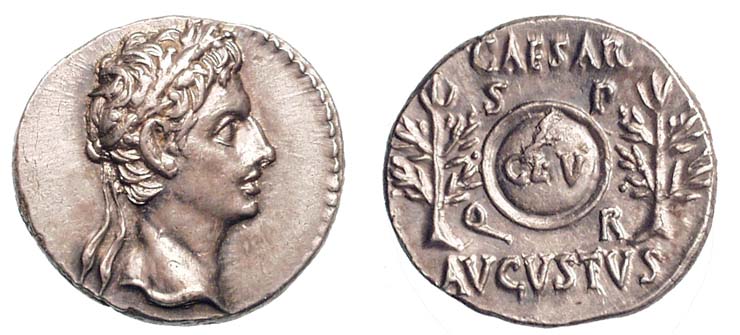
Augustus
(43-31 BC)
denarius, Spanish mint, 3.86g, S 1602, RF 1-1, 19/18 B.C.

Obv.  Laureate head of Augustus right
Rev. CAESAR AVGVSTVS S P Q R. Two laurel trees on either side of shield inscribed CL V, die break on shield

Claudius
(41-54)

Agrippina Jr.

cistophorus, Ephesus mint, 11.3g, RIC 117, RF 4-1, ex Sternberg, 41 A.D.

Obv. TI CLAVD CAESAR AVG PM TR P X IMP, head r
Rev. AGRIPPINA AVGVSTA CAESARIS AVG, bust r

Domitian
(81-96)
denarius as Caesar, 3.2g, RIC 297, RF 11-1, ex Millennia, 76 A.D.

Obv. DOMITIANVS laureate head head of Domitian r
Rev. COS IIII Pegasus standing r, wings upright, foreleg lifted

Titus
(79-81)
denarius as Augustus, 3.53g, RIC 131, RF 10-1, January-June 80 A.D., ex A. Lynn

Obv. IMP TITVS CAES VESPASIAN AVG P M, laureate head of Titus right / TR P IX IMP XV — COS VIII P P
Rev. Dolphin above struppus (crown formed from bundled sacred boughs) resting on cover set on handles of filleted tripod, partially occluded by two ravens standing back-to-back before.

Trajan
(98-117)
denarius, 3.5g, RIC 9, RF 13-1, 98/99 A.D.

Obv. IMP CAES NERVA TRAJAN AVG GERM (Trajan Augustus, conqueror of Germany) head of Trajan r
Rev. PM TRP COS II PP (Pontifex Maximus, Tribune, Consul 2 times, Father of his country [Pater Patraie]) Vesta, seated holding patera and torch

Trajan
(98-117)
denarius, 3.2g, RIC 38, RF 13-2, 100 A.D.

Obv. IMP CAES NERVA TRAJAN AVG GERM (Trajan Augustus, conqueror of Germany) head of Trajan r

Rev. PM TRP COS III PP (Pontifex Maximus, Tribune, Consul 3 times, Father of his country [Pater Patraie]) Pax standing holding branch and cornucopia

Hadrian
(117-138)
denarius, 3.5g, RIC 161, RF 14-1, 124/128 A.D.

Obv. HADRIANUS AVGVSTVS Laureate bust right, slight drapery on far shoulder
Rev. COS III Roma standing left, holding Victory on globe and reversed spear

Antonius Pius
(138-161)
denarius, 3.5g, RIC 95, RF 15-1, 140/141 A.D.

Obv. ANTONINVS AVG PIVS PP (Antoninus Augustus Pius) laureate head of Antoninus r
Rev. TR POT COS III (Tribune, Consul 3 times) Romulus suckling

Diva Faustina
Senior
denarius, 3.4g, RIC 360, RF 15A-2, after 141 A.D.

Obv. DIVA FAVSTINA (Divine Faustina) draped bust
Rev. AVGUSTA ceres (Aetemitas?) standing

Diva Faustina
Senior
denarius, 3.1g, RIC 377, RF 15A-1, after 141 A.D.

Obv. DIVA FAVSTINA (Divine Faustina) draped bust
Rev. AVGUSTA scepter and wreath on draped throne of Juno

Antonius Pius
(138-161)
denarius, 3.5g, RIC 441, RF 15-2, 161 A.D.

Obv. DIVVS ANTONINVS (Divine Antoninus) bare head of Antoninus r
Rev. DIVO PIO (divine & Pius) horned altar enclosure

Marcus
Aurelius

(161-180)
denarius, 3.2g, RIC 159, RF 16-1, 166 A.D. 

Obv. M ANTONINVS AVG PARTH MAX bare head of Marcus r
Rev. TR P  XX IMP IIII COS III PAX, Pax standing l. holding branch and cornucopia
Geta
(209-211)
denarius, 3.5g, RIC 18, RF 26-1, 200 A.D. 

Obv. P SEPT GETA CAES PONT (as Caesar) bare head of Geta r
Rev. PRINC IVVENTVTIS Geta standing l. holding baton and scepter, trophy behind
Septimius
Severus
(193-211)
denarius, 2.8g, RIC 274, RF 22-1, 206 A.D. ex Frank Kovacs

Obv. SEVERVS PIVS AVG laureate head r.
Rev. LAETITIA TEMPORVM ship in coliseum, quadriga, animals

Freeman & Sear: " When Severus and Caracalla celebrated the 10th anniversary of their joint reign in AD 206, they marked the occasion with a highly unusual public spectacle: A giant ship with collapsible sides was built in the Coliseum arena. At a given signal, the sides fell away releasing an array of exotic wild animals for the crowds entertainment. The event in commemorated on the reverse of this coin, which depicts the ship and several beasts. For added measure, four racing chariots are also shown."


Caracalla
(198-217)
denarius, 3.5g, RIC 157, RF 25-3, 206 A.D. 

Obv. ANTONINVS - PIVS AVG laureate head r.
Rev. LAETITIA TEMPORVM ship in coliseum, quadriga, animals

matching issue with above coin (see description above)

ex A. Lynn


Caracalla
(198-217)
denarius, 3.3g, RIC 238a, RF 25-1, 214 A.D. 

Obv. ANTONINVS PIVS AVG GERM, (Antoninus Pius Augustus, conqueror of Germany)
Rev. PM TR P XVII COS IIII PP (Pontifex Maximus, Tribune 17 times, Consul 4 times, Father of his country [Pater Patraie]), Apollo seated left holding branch & leaning on lyre set on tripod
Caracalla
(198-217)
denarius, 3.1g, RIC 254, RF 25-2, 215 A.D. 

Obv. ANTONINVS PIVS AVG GERM, (Antoninus Pius Augustus, conqueror of Germany), bust r
Rev. PM TR P XVIII COS IIII PP (Pontifex Maximus, Tribune 18 times, Consul 4 times, Father of his country [Pater Patraie]), Apollo standing l, wearing polos and holding scepter
Julia Domna denarius, 3.1g, RIC 391, RF 22A-1, 215 A.D.

Obv. IVLIA PIA FELIX AVG (Julia Pius and Blessed Augusta), Julia Domna facing right;
Rev. VESTA, Vesta seated left holding simpulum and scepter
Macrinus
(217-218)
denarius, 3.9g, RIC 76, RF 27-1, 217 A.D.

obv: IMP C M OPEL SEV MACRINVS AVG 
Bust laureate, cuirassed r., seen from front, beard short
Rev. IOVI CONSERVATORI (Jupiter Savior) Jupiter standing l holding in r hand thunderbolt over small figure of Macrinus and in l hand scepter

Julia Mamaea
 
denarius, 3.2g, RIC 360, RF 30A-1, 226 A.D.

obv: IVLIA MA MAEA AVG, diademed bust r
Rev.  FECVND AVGVSTAE, Fecunditas standing l, child before, cornucopia
Severus Alexander
(222-235)
denarius, 3.2g, RIC 250, RF 30-3, 231 A.D.

Obv: IMP ALEXANDER PIVS AVG, Laureate bust right, slight drapery on far shoulder
Rev.  PROVIDENTIA AVG, Providentia standing left, holding grain ears and cornucopia; modius at her feet
Severus Alexander
(222-235)
denarius, 3.1g, RIC 238, RF 30-2, 231 A.D.

Obv: IMP ALEXANDER PIVS AVG, laureate, draped & cuirassed bust r
Rev.  IOVI PROPVGNATORI, Jupiter standing front, head right, nude but for cloak flowing out to left, hurling thunderbolt & holding eagle
Severus Alexander
(222-235)
denarius, 2.8g, RIC 254, RF 30-4, 232 A.D.

Obv: IMP ALEXANDER PIVS AVG, laureate, draped bust right
Rev.  SPES PVBLICA, (hope of the populace) Spes walking l, holding flower and raising skirt
Severus Alexander
(222-235)
denarius, 3.2g, RIC 123,  RF 30-1, 234 A.D.

Obv: IMP ALEXANDER PIVS AVG, laureate, draped bust right
Rev. P M TR P XIII COS III P P, Sol advancing left raising hand & holding whip
Maximinus Thrax
(235-238)
denarius, 3.0g, RIC 12,  RF 31-1, 235 A.D.

Obv: IMP MAXIMINVS PIVS AVG, laureate, draped and cuirassed bust right 
Rev: PAX AVGVSTI, Pax standing left with branch & scepter
Maximinus Thrax
(235-238)
denarius, 2.4g, RIC 14,  RF 31-2, 235 A.D.

Obv: IMP MAXIMINVS PIVS AVG, laureate, draped and cuirassed bust right 
Rev: SALVS AVGVSTII Salus seated left extending patera to snake rising from altar
Maximinus Thrax
(235-238)
denarius, 2.9g, RIC 16,  RF 31-3, 235-36 A.D.

Obv: IMP MAXIMINVS PIVS AVG, laureate, draped and cuirassed bust right 
Rev: VICTORIA AVG, Victory advancing right holding branch and palm
Gordian III
(238-244)
denarius, 2.8g, RIC 81, RF 36-2, 240 A.D.

Obv.  IMP GORDIANVS PIVS FEL AVG, laureate, draped, & draped bust right 
Rev. P M TR P III COS P P, Gordian riding l on horseback, holding spear, r hand raised

Gordian III
(238-244)
denarius, 2.9g, RIC 114, RF 36-1, 249 A.D.

Obv.  IMP GORDIANVS PIVS FEL AVG, laureate, draped, & cuirassed bust right 
Rev. P M TR P III COS P P, Apollo seated left holding branch in right hand.

Philip I
(244-249)
antoninianus, 4.7g, RIC #27b (Eauze Hoard), RF 37-1, 247 A.D.

Obv. IMP M IVL PHILIPPVS AVG (Emperor Philip [the Arab] Augustus),  Philip I facing right Bust radiate, draped, ciurassed
Rev. AEQVITAS AVGG (Goddess in aspect of emperor), Goddess Aequitas (equity) standing left, hair gathered at top of head, holding scales in r. hand, r, forearm bent upwards, cornucopia in l., no drapery from l. arm.   

Philip II
antoninianus, 5.0g , RIC 216c, RF 37A-1, 248 A.D.

Obv. IVL PHILIPPVS CAES, radiate, draped & cuirassed bust right
Rev. PRINCIPI IVVENT, Philip II, in military dress, standing r with globe & transverse spear.

Probus
(276-282)
silvered billion antoninianus, Siiscia mint, 3.6 , RIC 776, RF 71-1, 277 A.D.

Obv. IMP C M AVR PROBVS PF AVG radiate bust left in imperial mantle, holding eagle-tipped scepter
Rev. SOLI INVICTO XXIVI, Sol in unruly quadriga facing


Richard Frajola (December 2009)